

Virginia's Agricultural Cost-Share Program to Improve Water Quality

WHY WE DID THIS STUDY
In 2025, the Joint Legislative Audit and Review Commission (JLARC) directed staff to review the Virginia Agricultural Best Management Practices Cost-Share (VACS) Program.
ABOUT VACS
Created in 1984, VACS provides financial incentives for agricultural producers to implement best management practices to reduce nonpoint source pollution in Virginia bodies of water. Agricultural lands are a significant source of nonpoint pollution. Nearly 30 percent of Virginia’s total land area (about 7.2 million acres) is agricultural, and the nitrogen, phosphorus, and sediment pollution from agriculture can be especially harmful to the Chesapeake Bay and other bodies of water.WHAT WE FOUND
VACS program has grown substantially, paying for producers to implement agricultural practices that reduce pollution
The General Assembly has substantially increased VACS funding for agricultural best management practice (BMP) implementation over the last few years. VACS funding has exceeded $200 million in each of the last three years, increasing to more than $300 million in FY27. When adjusted for inflation, VACS BMP funding has increased over 300 percent since FY17, around when Virginia’s current Chesapeake Bay Phase III Plan to reduce pollution was implemented.
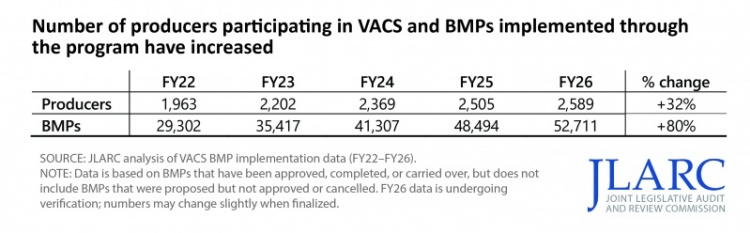
The increased funding has led to higher program participation. During the last five years, the number of producers (i.e., farmers) participating in VACS has grown by more than 30 percent to nearly 2,600 in FY26 (table).
These producers have implemented an increasing number of agricultural BMPs, which are scientifically shown to reduce agricultural pollution into the state’s waters, including the Chesapeake Bay. In FY26, producers implemented nearly 53,000 BMPs (such as cover crops or stream exclusion fencing for livestock)—an 80 percent increase during the last five years. Scientific research shows that nearly all (62 of 64) VACS BMPs reduce pollution to some degree. Once verified as properly implemented, these practices are credited with reducing nitrogen, phosphorus, and/or sediment in the Chesapeake Bay Program model.
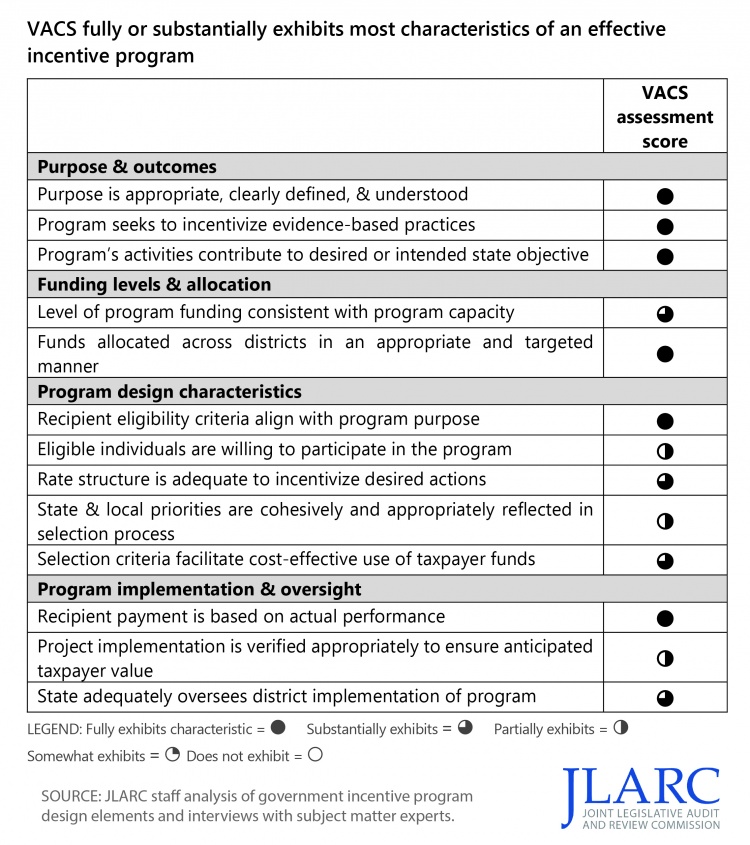
VACS fully or substantially exhibits most characteristics of an effective incentive program but can be further improved
Assessing VACS against the characteristics of an effective incentive program shows that VACS is largely an effective program. VACS seeks to incentivize producers to use evidence-based practices, establishes eligibility criteria that align with the program’s purpose, and uses a performance-based payment structure so recipients are paid only after demonstrating they have properly implemented the required BMP(s).
Although the program is largely effective, certain aspects of the program can be improved. For example, program funding amounts could be more consistent with the program’s actual capacity, and several aspects of the program’s design, implementation, and oversight should be improved.
If VACS funding declines, prioritizing cost-effective VACS BMPs for awards will become increasingly important
High VACS funding in recent years has made project award prioritization less important. High funding levels allowed many districts (especially in the Chesapeake Bay watershed) to approve nearly all eligible BMP applications without needing to prioritize the most cost-effective applications.
If VACS funding decreases, though, it will be increasingly important for the state to optimize VACS spending on the most cost-effective BMPs (sidebar). Although Virginia has mechanisms designed to encourage the cost-effective use of VACS funds, the state does not currently have a list of the most cost-effective VACS BMPs. Developing and using this information to help districts prioritize projects can help ensure the state maximizes pollution reductions achieved with available VACS funding.
Funding needs assessments are largely appropriate, but implementation assumptions lead to unobligated funds
The state uses assessments to determine VACS funding needs, and both assessments rely on relevant and available data. The assessment to determine the distribution of funds across districts is especially useful because it is informed by a rigorous pollution evaluation that identifies parts of the state at “high,” “medium,” and “low” risk for nitrogen, phosphorus, and sediment pollution.
However, the assessment the state uses to estimate total VACS funding needs is optimistic about BMP implementation, which has led to a substantial amount of funds being appropriated but not obligated (figure).
Amount of unobligated VACS funding grew amid recent funding increase
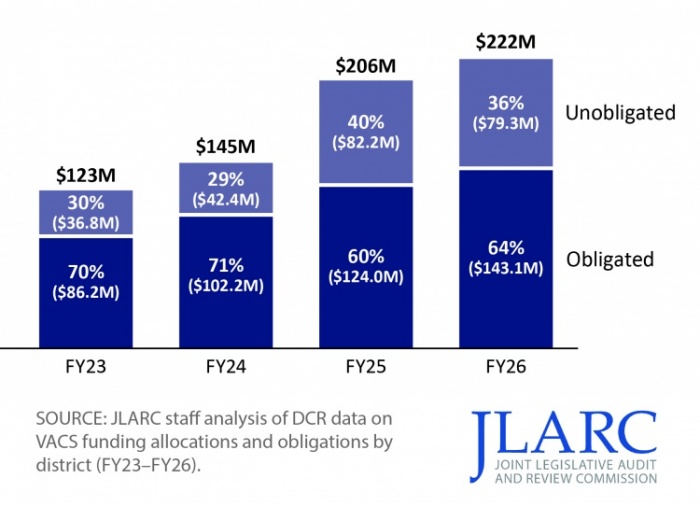
Actual producer implementation has been below the amount of BMPs the assessment assumes are needed by the end of FY27 to meet the state’s 2028 Phase III Chesapeake Bay Watershed Implementation Plan deadline. These appropriated, but unobligated, funds could have been used for other state initiatives.
Districts and DCR conduct producer outreach, but analyzing local and state data could help reach nonparticipants
Outreach is essential to raising awareness of the VACS program and encouraging producer implementation. Without adequate producer participation, the state cannot meet its agricultural pollution reduction goals. Outreach efforts include marketing the program to producers, building rapport with them, and informing them of updates, such as changes in specifications and reimbursement rates.
A potentially substantial number of eligible Virginia producers do not participate in VACS, though the exact number and their willingness to participate are not known. Some stakeholders suggest that most interested producers already participate in the VACS program, but no systematic data analysis has been performed to validate this perception. Integrating local data with state environmental and agricultural datasets could help identify eligible nonparticipating producers and enable targeted outreach to expand program participation.
VACS program design is largely effective and reasonable
VACS aims to incentivize producers to implement BMPs by reimbursing them for a portion of the BMP implementation costs. VACS is relatively effective at incentivizing desired behavior compared with other incentive programs previously evaluated by JLARC (figure).
VACS influences behavior more than the average economic incentive
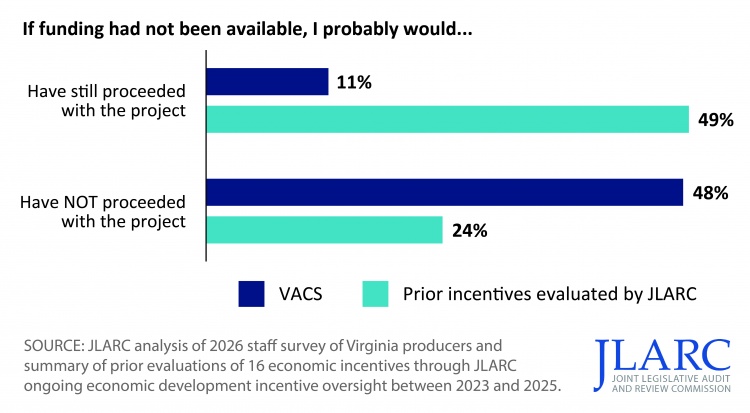
The specific cost-share rates for each BMP seem to effectively incentivize producers to implement BMPs, with inadequate funding rarely cited as a reason for not participating. Furthermore, using higher cost-share rates for some BMPs seems to encourage producers to implement more desirable practices, such as longer-duration practices. This suggests that temporarily raising cost-share rates for the most cost-effective BMPs could further encourage producers to use these practices.
State priorities are too broad, and Whole Farm Approach seems effective but may be overly prioritized
Existing policies at the state level (five “priority considerations”) and district level (“secondary considerations”) do not result in a cohesive process that ensures the most cost-effective BMPs receive awards. In practice, the current process gives more weight to district priorities than state priorities and may not always prioritize the most cost-effective BMPs. Because state policies are too broad to effectively prioritize VACS applications, districts’ secondary considerations become the main determinant of awards for districts that currently prioritize applications.
A relatively new VACS subprogram seems effective but may be overly prioritized by VACS’s current funding allocation. Created in 2020, the Whole Farm Approach (WFA) VACS subprogram has expanded the number of producers and/or fields with cover crop and nutrient management BMPs, helping Virginia make progress toward its Chesapeake Bay Phase III goals. The majority (70 percent) of VACS BMPs implemented in FY26 were WFA BMPs which are funded from a separate allocation of VACS funds. This separate funding allocation has been helpful for some districts that expend all their non-WFA VACS funds. Because of this separate funding, though, WFA BMPs are not assessed against other BMPs to determine which are the most cost-effective at reducing pollution.
Process to verify producer compliance is generally effective, but inconsistent for cover crops
The process to verify producer compliance is generally effective. Before a producer can receive VACS funding, district staff must verify whether the BMP has been implemented according to relevant specifications. Many of these verifications require in-person inspections by district staff. A district may not authorize payment to a producer until staff have verified the implemented BMP meets all relevant specifications.
The cover crop BMP is one of the most common practices, but districts do not appear to consistently verify whether cover crops achieve sufficient soil coverage by early winter, as required. Cover crop BMPs are subject to three different verifications to ensure they meet state specifications and achieve their expected pollution reduction. However, districts use widely varying methods to verify cover crop coverage. Moreover, some cover crop BMPs that do not achieve 60 percent coverage are likely not being cancelled, according to multiple stakeholders. District staff may be reluctant to cancel awards when producers made a good faith effort to fulfill their obligations because the producer would not be reimbursed for the materials and labor used to plant cover crops. If districts do not consistently and accurately identify whether cover crops reach adequate coverage, the pollution reductions recorded for those BMPs may be overestimated.
WHAT WE RECOMMEND
Legislative action
- Direct the development of a ranked list of the cost-effectiveness of agricultural BMPs, making the list available to districts to help inform award decisions.
- Direct the revision of the process to award funding to better ensure that the most cost-effective agricultural BMPs are consistently prioritized.
Executive action
- Implement a pilot program to identify potentially eligible producers, using the results to help recruit more producers to participate.
- Implement a pilot program to temporarily increase cost-share rates for the most cost-effective agricultural BMPs.
- Establish standardized methods and guidance for soil and water conservation district staff to verify cover crop soil coverage.
- Train district staff on acceptable methods for verifying cover crop soil coverage.
The full list of recommendations is available here.