

Film, Media, and Tourism Incentives

WHY WE DID THIS STUDY
Through language in the Appropriation Act, the General Assembly directed the Joint Legislative Audit and Review Commission (JLARC) to review and evaluate economic development initiatives. Topics include spending on incentives and activity generated by businesses receiving incentives; the economic benefits of incentives; and the effectiveness of incentives.
JLARC releases two reports each year: a high-level summary report on overall spending and business activity and an in-depth report on the effectiveness of individual incentives. (See Appendix A: Study mandate.) JLARC contracts with the Weldon Cooper Center for Public Service to perform the analysis for both reports.
This report is the 10th in the series of in-depth reports on the effectiveness of individual incentives and focuses on Virginia’s film, media, and tourism incentives.
ABOUT VIRGINIA'S FILM, MEDIA, AND TOURISM INCENTIVES
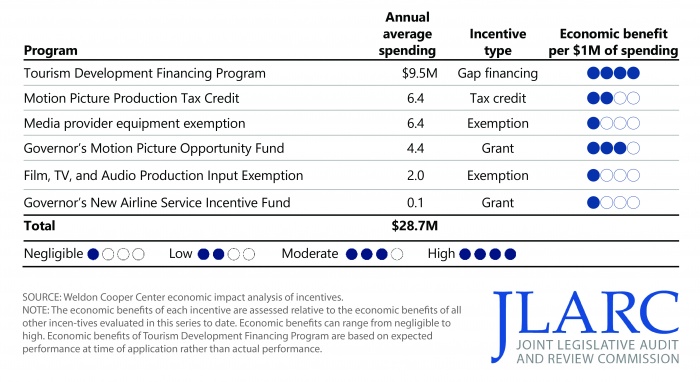
Virginia provides six incentives to encourage film, media, and tourism activity in the state. Spending on these incentives averaged $29 million annually between FY15 and FY24 and totaled $287 million over this period. The majority of spending was for three film incentives, though the largest spending commitment was for gap financing for the Tourism Development Financing Program. The six film, media, and tourism incentives comprised about 5 percent of total spending on state economic development incentives between FY15 and FY24.
Incentivized film activity varied widely from year-to-year, making it difficult for state to develop a sustainable film industry
Virginia offers three incentives to attract film and television productions: a tax credit, a grant, and a sales and use tax exemption. The tax credit alone accounts for half of all film incentive spending. While film incentive funding has been relatively stable, incentivized film production activity has fluctuated significantly each year. Along with this fluctuation, tax credit awards have been uneven from year to year with several large tax credit awards in FY 19 constraining the Virginia Film Office’s ability to award new credits in subsequent years.
Stakeholders indicate this volatility in film production makes it difficult to retain the experienced crews, specialized vendors, and soundstage infrastructure essential for growing and sustaining a film industry. Although film industry employment in Virginia has grown since 2015, the state still accounts for only about 1 percent of U.S. film employment and has a low concentration of film jobs relative to other states, further limiting its ability to develop a sustainable industry.
The film grant generates the highest economic benefits of the three film incentives. Compared to other incentives, the economic benefits of the film grant are moderate, while the benefits of the film tax credit and film exemption are low and negligible, respectively. However, the economic benefits of all three of the film incentives are temporary. Unlike programs that support long-term business location and expansion, the economic impacts of film incentives cease once production ends.
Tourism Development Financing Program addresses lodging deficiencies and has high economic benefits and returns in state revenue
The Tourism Development Financing Program provides gap financing for qualified, large‑scale tourism projects that are unable to secure full private financing. Gap‑financed debt is repaid over time by the state, the locality, and the developer. The state’s repayment share is funded through a portion of the state retail sales and use tax revenues generated by the project, with the locality and developer each contributing matching shares.
The Tourism Development Financing Program is designed to address documented lodging deficiencies in the state, and local economic development staff report that it fills an important gap in tourism-related development. To date, supported projects have included higher-end lodging and recreation, conference, and wellness-oriented resort space, which are most closely associated with overnight visitation and higher visitor spending. The program generates high economic benefits and state revenue returns compared with other incentives; however, these estimates are based on projected investment and employment reported in applications rather than verified outcomes.
Governor’s New Airline Service Incentive Fund has no influence on air service decisions and negligible economic benefits
The Governor’s New Airline Service Incentive Fund (new airline service grant) provides small grants to airlines to support marketing and promotion of new passenger service at Virginia’s commercial airports. However, the grants—ranging from $5,000 to $25,000—are too small to meaningfully offset the startup risks or large fixed costs associated with expanding air service, such as gate access and ground-handling fees. Airlines serving Virginia may also have access to larger subsidies from federal programs and the airports themselves, and stakeholders report that the application process for the grant is lengthy and burdensome relative to its size. Broader macroeconomic conditions, airline industry trends, and regional economic and demographic factors play a far greater role in air service decisions than this small grant. While the grant may not influence decisions on new routes, it may contribute to the success of new air service by supporting marketing and promotional efforts. The new airline service grant has negligible economic benefits and returns in state revenue compared with other incentives. When accounting for the cost to the state of providing the grant, the program has a negative impact on Virginia GDP and personal income
Media provider equipment exemption generates negligible economic benefits for the state but may have other benefits
The media provider equipment sales tax exemption reduces the tax burden on radio and television broadcasting, cable television, and certain telecommunications services. The exemption was expanded in 2022 to include network-related equipment as part of the state’s goal to provide universal broadband access, more than doubling spending on the exemption (increasing from around $5 million annually in FY15 to $11.4 million in FY24). The exemption is now the fourth-largest economic development exemption reviewed in this series.
The exemption generates negligible economic benefits and state revenue returns and, when accounting for the forgone revenue to the state of providing the exemption, it results in negative economic activity. However, the exemption may encourage investment in broadband equipment, and expanded access to broadband may have meaningful economic and social benefits for underserved and rural areas.
Film, media, and tourism incentives have economic benefits ranging from high to negligible (FY15–FY24)
WHAT WE RECOMMEND
Legislative action
- Provide an additional 5 percent film tax credit for multi-season productions.
- Adopt a formal allocation award method for the film tax credit based on award size and target awards to productions that rely on unique Virginia characteristics.
- Direct a streamlined application process for the new airline service grant if it is maintained.
- Broaden the uses of the new airline service grant if it is maintained.
- Conduct a comprehensive review of the media provider equipment exemption to assess whether it advances worthwhile state goals and whether it could be better structured.
Executive action
- Review sales tax remittance process for the Tourism Development Financing Program to determine if it could be made less administratively burdensome.
- Require an interim review of Tourism Development Financing Program projects five years after each project award to improve project oversight and evaluation.
A full list of recommendations and policy options is availabe here.