

Effects of Community Gun Violence in Virginia

WHY WE DID THIS STUDY
In 2024, the Virginia General Assembly passed House Joint Resolution 76, directing the Joint Legislative Audit and Review Commission (JLARC) to review the effects of gun violence on communities across the Commonwealth. Specifically, JLARC was directed to assess the impact of gun violence on the physical, mental, and emotional health of individuals living in communities affected by gun violence and the overall social and economic health of those communities.
ABOUT VIRGINIA'S GUN VIOLENCE IN VIRGINIA
Gun violence encompasses any crime committed with a firearm, from violent crimes (murder, assault, robbery) to those of intimidation (brandishing, non-injury shootings). Over the past 15 years, the proportion of total criminal offenses committed using a firearm grew from 11 percent in 2009 to 16 percent in 2023. Gun crimes make up an even higher proportion of violent crimes. Virginia, like much of the country, recently experienced a surge in gun violence during the COVID-19 pandemic, but gun violence rates have begun to fall. Violent crime in Virginia—including homicides, assaults, and robberies—remains below historical highs.
WHAT WE FOUND
Virginia’s gun violence rate is about average compared with other states, but rates in a few Virginia cities are relatively high
Virginia ranks 23rd highest among states for violent firearm offenses, with 88 per 100,000 residents annually on average (slightly below the 50-state average of 93). Virginia’s statewide gun homicide rate was 5.4 per 100,000 people, which was 21st highest among the states and equal to the national average.
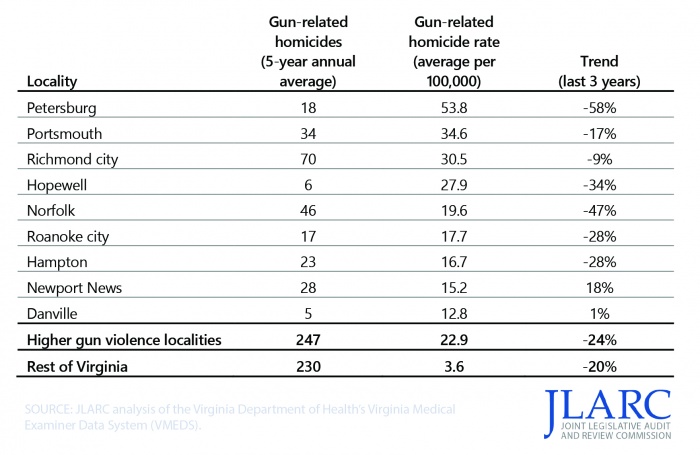
While Virginia’s gun violence problem statewide is about average compared with other states, certain localities have relatively high rates of gun violence incidents. Just nine Virginia localities accounted for over half of all gun-related homicides in the state (see table). Violent crimes in these nine localities are especially likely to involve a firearm, including 87 percent of murders, 61 percent of robberies, and 56 percent of aggravated assaults (compared with 72 percent of murders, 40 percent of robberies, and 35 percent of aggravated assaults across the rest of the state).
Community violence is the main driver of higher gun violence levels and puts wider communities at risk
Community violence, which is the focus of this study, was the main type of gun violence in the nine Virginia localities with higher gun violence rates. Community violence is interpersonal violence that often takes place in public spaces and puts the broader community at risk. Community violence not only affects victims and their families but the overall social health of a community. In some neighborhoods, shootings are so frequent that residents fear for their own safety, even if they are not involved in a conflict and are not an intended target. In Virginia’s nine higher gun violence localities, shootings are concentrated in and around a few neighborhoods, with some neighborhoods averaging three or more gun-related homicides annually. For each gun-related homicide, there are several non-fatal shootings, meaning that these neighborhoods experience more gun violence than the homicide data alone indicates.
Nine Virginia localities had higher rates of gun-related homicides compared with the rest of the state (2020–2024)
The abundance of firearms makes them easily obtainable. Recent estimates place the number of firearms in circulation in the U.S. at 400 million, with 11.6 to 23.4 million new firearms added each year over the last decade. This large pool of guns can be accessed through different means, including legal purchase, illegal purchase, theft, or by obtaining a gun owned by a partner, friend, or family member. The ease of obtaining a gun because of the large number already in circulation, especially in high-gun violence localities, is both a reality and concern consistently expressed by stakeholders interviewed for this study. Data from the Bureau of Alcohol, Tobacco, Firearms and Explosives indicates that in about 60 percent of criminal cases in Virginia where firearms were recovered, the person using the gun was not the last known legal purchaser, suggesting that they may not have obtained it legally.
Firearm injuries tend to be more lethal, severe, and costly to treat than other assault injuries
Among the many effects of community firearm violence, the most direct are on the physical health of individuals injured by gunshot wounds. Research indicates that victims of firearm assault injuries are more likely to die before reaching the hospital compared with victims of stab wounds, another common type of assault injury, and they are more likely to die from their injuries even if they reach a hospital for care. Furthermore, non-fatal firearm injuries are typically more severe than other types of non-fatal penetrating injuries and blunt trauma.
Firearm injuries are relatively expensive to treat compared with other types of traumatic injuries because they require more resources and longer hospital stays. Analysis of Virginia healthcare claims data indicates that, statewide, more than one-third of firearm injury patients require inpatient hospital admission. On average, inpatient treatment costs for firearm injuries are about one-and-a-half to two times the cost of treating stab wounds and about two to three times the cost of treating injuries caused by blunt objects or bodily force. In Virginia, inpatient treatment costs range widely based on the severity of the injury and were especially high for the top quartile of cases, which ranged from about $34,600 to over $232,000. Medicaid largely bears the initial cost of firearm injuries, though these costs represent a minimal share of total Medicaid expenditures (less than 0.05 percent).
Firearm injury survivors are more likely to require additional care after discharge than survivors of other assault injuries, and many experience long-term health effects. However, many firearm injury survivors have difficulty accessing the follow-up care needed after leaving the hospital, which can lead to poorer long-term health outcomes and higher treatment costs. In Virginia, approximately 30 percent of firearm injury survivors require some further care after being discharged from the hospital.
Survivors of firearm injuries and young people exposed to gun violence are at increased risk for developing mental health conditions
Firearm injury survivors are at significantly higher risk of experiencing several psychiatric disorders compared with people injured through other non-violent means and the general population. One well-designed national study found that psychiatric disorders among firearm injury survivors increased 200 percent relative to control participants in the month after their injury.
Youth and young adults are more likely than other age groups to be exposed to gun violence, and exposure to community gun violence puts young people at risk of a spectrum of developmental challenges and clinical mental health disorders. Research has shown that very young children exposed to trauma or toxic stress are more prone to developmental challenges, including difficulties with emotional regulation, language development, cognitive reasoning, and problem solving and are predisposed to developing clinical mental health conditions later in life. For older children and adolescents, exposure to gun violence often contributes to or exacerbates the development of PTSD, depression, and anxiety, as well as conduct disorders and behavioral challenges associated with emotional regulation. Young people who have been repeatedly exposed to gun violence may be more likely to respond to the shooting of a friend with anger and seek retribution, and they are also more likely to carry firearms for protection, significantly increasing their risk of involvement in a violent incident.
Each of the nine localities with the highest rates of community firearm violence in Virginia are designated as mental health professional shortage areas for low-income populations, according to the Health Resources and Services Administration. Mental health providers, hospital staff, and staff of other community-based organizations in these communities reported that there is an especially pronounced shortage of trauma-focused, culturally competent mental health services in their communities, especially for youth.
Gun violence negatively affects local economies, including business activity and property values
A growing body of research literature has found that violent crime—and gun violence in particular—depresses business activity. Bar and restaurant owners in several of Virginia’s higher gun violence localities reported closing early because they see little traffic later in the evening and are concerned about customer and employee safety. They indicated that while commercial areas are generally safe, they are often perceived as unsafe due to shootings or violent crimes that occur late at night. Over the longer term, areas with persistently higher levels of shootings and violent crime can see reduced business. Several studies have found that an increase in gunshots or violent crime was associated with fewer new businesses and the downsizing or loss of existing businesses. Operating businesses in higher gun violence communities can also be expensive and complex. For example, businesses in these areas often must pay for enhanced security measures and higher insurance premiums.
Violent crimes, including shootings, are associated with reduced residential and commercial real estate values. For example, one study found that a 10 percent increase in violent crimes in a neighborhood reduced housing values by as much as 6 percent, and another study found that each day with a nearby gunfire incident reduced sales prices by 9.6 percent. Commercial property values can also be affected by nearby violent crime, making it more difficult to fully lease spaces and depressing market lease rates. Depressed values affect property owners and local governments, who rely on real estate property taxes for 50 percent of their revenue, on average.
Increased gun violence can strain already short-staffed law enforcement agencies
High levels of gun violence strain local law enforcement, affecting their operational capacity, particularly during officer shortages. Statewide, the number of full-time law enforcement officers declined about 3 percent from 2020 to 2022. However, departments in several higher gun violence localities had much larger declines, including Richmond, Norfolk, Portsmouth, Hampton, Petersburg, and Roanoke city. As the local entity primarily responsible for preventing, responding to, and investigating incidents, increases in gun-related violent crimes like homicides and assaults divert limited law enforcement resources from lower-crime areas and other investigations. Responding to these incidents can require more personnel (e.g., securing a perimeter) and longer times to clear crime scenes. Investigating and prosecuting gun violence incidents is also personnel- and time-intensive.
Community gun violence negatively affects student attendance and classroom engagement, exacerbates school staffing issues
Public schools serving communities with higher levels of gun violence face distinct and complex challenges that negatively affect students and staff. Exposure to gun violence leads to trauma and fear among students, reducing their sense of safety, and increasing absenteeism and disruptive behaviors. A 2024 survey conducted by the Department of Criminal Justice Services (DCJS) found high school students in Virginia’s nine higher gun violence localities were more likely than the statewide average to report they do not feel safe traveling between home and school and while on school grounds or in hallways and bathrooms. School divisions in communities with high gun violence rates also have higher chronic absenteeism rates than the state average. Research literature links exposure to community violence to lower test scores, increased grade level repetition, and decreased high school graduation rates.
For school staff in higher gun violence communities, the threat of violence and emotional strain worsen recruitment and retention, resulting in higher vacancy rates than the state average. This environment also necessitates increased security investments, such as more infrastructure and personnel; divisions in the nine highest-violence localities employ an average of 3.2 security staff per 1,000 students, compared with 2.0 elsewhere.
Strategies for preventing and addressing gun violence effects have been implemented to varying degrees in higher gun violence localities
Addressing community gun violence requires effective prevention and intervention programs, combined with programs that respond to gun violence incidents. In Virginia, all nine higher gun violence localities have city- or nonprofit-operated “intensive mentorship-based prevention programs” for high-risk youth that include the key elements that research has found necessary for them to be effective. Additionally, several Virginia localities have credible messenger “violence interruption programs” including Newport News, Norfolk, Hampton, Hopewell, Portsmouth, and Roanoke city. In addition, most Virginia localities with high gun violence rates also have hospital-based violence intervention programs, which engage with injured gun violence survivors during the critical period when victims are in the hospital immediately following an assault to help prevent retaliation and reinjury. Some localities in Virginia have developed dedicated stabilization and case management teams to provide immediate, non-medical assistance to victims, families, and communities following gun violence incidents. While a locality may have one or several of these different programs in place, gaps in programming and services still exist and existing programs do not necessarily reach all communities and individuals in need.
A community also needs effective law enforcement and criminal prosecution to address gun violence. Across Virginia’s higher gun violence localities, police departments reported using a variety of strategies to better respond to and prevent future incidents. These initiatives range from new staffing models designed to ensure timely investigation of gun violence incidents to gunshot detection systems for quickly pinpointing and responding to incidents. Research literature suggests that the staffing and technology strategies being used in these Virginia localities are effective at responding to and reducing gun violence. Additionally, police departments are expanding their community engagement initiatives to improve relations and reduce gun violence. These initiatives are funded by several sources, including state funds. State grant funds have also been used to help provide additional resources for commonwealth’s attorney offices in several higher gun violence localities.
Relatively new state programs and funding have facilitated local responses, but additional assistance should be considered for some higher gun violence localities
While local governments are best positioned to provide the central leadership, planning, and coordination for gun violence prevention programs, the state can provide technical assistance and funding to help ensure that Virginia localities most affected by gun violence are able to implement well-designed and well-coordinated programs.
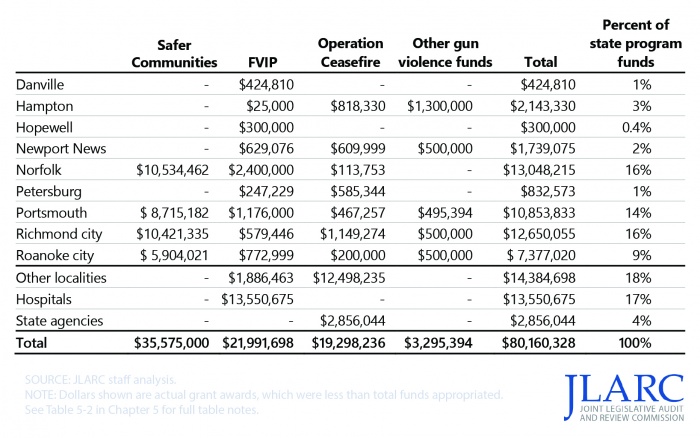
State initiatives to support local gun violence reduction efforts have increased significantly over the past few years. Between FY21 and FY26, the state increased the funds appropriated to support local efforts by about $30 million. The state also established the DCJS Office of Safer Communities, which oversees three gun violence reduction funding programs: Safer Communities (established in 2023), Firearm Violence Intervention and Prevention (FVIP, 2022), and Operation Ceasefire (2022).
Most of Virginia’s nine higher gun violence localities have received some gun violence reduction assistance from the state, but funding and technical assistance is not distributed in accordance with need. For example, Petersburg has the highest annual average gun homicide rate in the state yet receives only 1 percent of all state program funds for gun violence response (table). Additionally, Hampton and Newport News have gun homicide rates comparable to Roanoke city, but they receive 3 percent and 2 percent of state program funds, respectively. Furthermore, the state’s largest gun violence reduction funding program, Safer Communities, provides funding for only four of Virginia’s higher gun violence localities. Localities that do receive Safer Communities funding have reported difficulty spending their appropriated funding because of restrictive disbursement and spending rules that have hindered planning and effective program implementation.
In addition, DCJS regularly convenes “community of practice” meetings with funding recipients, including FVIP and Operation Ceasefire grantees and the Safer Communities localities, but not all the higher gun violence localities meet together. These meetings are used to share information on state initiatives and administrative matters, highlight emerging program designs, discuss local implementation of gun violence reduction strategies, and provide a general forum for information exchange. However, none of these meetings include all nine localities with the highest rates of gun violence. For example, meetings about the Safer Communities initiative do not include Hampton, Newport News, Danville, Hopewell, and Petersburg, even though officials in these cities would likely benefit from participating.
State funding for gun violence reduction efforts through DCJS (FY21–FY26)
WHAT WE RECOMMEND
Legislative action
- Allow unspent Safer Communities grant funding to revert to the state at the end of the biennium for which it was appropriated, rather than annually.
- Direct DCJS to periodically evaluate if changes are needed to how Safer Communities funds are distributed among Virginia localities (such as changes to the formula for distributing funds).
- Direct DCJS to periodically evaluate if changes are needed to funding amounts or qualifications for FVIP and Operation Ceasefire grants.
Executive action
- DCJS should expand its “community of practice” meetings to include representatives from Danville, Hampton, Hopewell, Newport News, Norfolk, Petersburg, Portsmouth, Richmond, and Roanoke city.
Policy option to consider
- Amend the Appropriation Act to extend Safer Communities funding to the cities of Danville, Hampton, Hopewell, Newport News, and Petersburg.
The full list of recommendations is available here.